Posted by Alex Karapetian
In : Blog Archive
Download our free, new whitepaper “Five Challenges Engineers Face in Power Supply Design”. This resource shows how Acopian can solve many design challenges:
- physical size
- non-standard AC & DC inputs
- non-standard output voltages
- ruggedization
- component obsolescence
Sometimes companies still need a more traditional power supply solution. Acopian’s website enables customers to find an appropriate power supply from an existing selection of more than a million power supplies, shipped within 3 days and built to demanding standards.
Download Now
Add Comments
Posted by Acopian Power Supply
In : Blog Archive

“At Project IceCube, it’s absolutely critical to have a good power supply. The ice must be as pure and clear as possible. If the power to the ice top senor system were to fail, we would risk the tank water freezing without being controlled, resulting in bubbles and impurities, and very much reducing the quality of ice and quality of information that we can see with our detectors. We chose Acopian power supplies to power our pumping and degassing systems because of their reputation for reliability. The people at Acopian met all of our highly demanding specifications and, despite very little time until our window to ship to the Pole, they met our schedule. We were 100 percent satisfied.”
– Jim Baccus, Cable System Manager, Project IceCube.
When scientists were developing the IceCube Neutrino Observatory at the South Pole in Antarctica and needed a rugged, reliable power supply for the observatory’s pumping and degassing systems, they chose an Acopian switching power supply. Specifically, they chose our Narrow Profile, Switching Regulated, AC-DC, Single Output power supply with Power Factor Correction and Universal Input – to keep these essential systems operating.
Functioning continuously in the coldest place on earth – a climate with an average annual temperature of -57.1 °F – and supporting a project that involves approximately 300 physicists and engineers from 12 countries, Acopian power supplies help keep polar ice clear and free of bubbles and impurities so the project’s 5,160 highly sensitive, digital-optical modules embedded in a cubic kilometer of ice can search for and detect high-energy neutrinos resulting from violent, astrophysical sources such as exploding stars, gamma-ray bursts, and cataclysmic phenomena involving black holes and neutron stars.
Acopian’s reputation for rugged reliability has led us to the ends of the earth and to reach for the stars for our customers.
Find out what we can do for you.
In celebrating its 58th anniversary, Acopian remains the leader in the power supply industry, manufacturing millions of models of AC-DC power supplies and DC-DC converters. Models include linear, switching, unregulated, programmable, high voltage, redundant and custom power supplies ranging from 0v to 30kV and up to 1400 watts. Acopian power supplies are made in the USA and shipped within 3 DAYS!
To see our range of switching power supplies, click here.
Add Comments
Posted by Acopian Power Supply
In : Blog Archive
We make millions of standard power supplies, but Acopian may be best known for our ability to create custom power supply systems designed to your exact needs and specifications. Acopian custom power supplies are ultra reliable, made in the USA, fully wired and tested, come with a 5-year warranty, and ship within 9 days of order! The possibilities are endless! For Acopian reliability made to order, use our convenient, online Custom Power Supply System Builder. What can we customize for you?

#poweryourway #acopianpowersupply #acopian
Add Comments
Posted by Acopian Power Supply
In : Blog Archive
Visit our booth at this year’s Applied Power Electronics Conference at the Charlotte Convention Center, now through March 19. See some of our many products, and talk with our engineers to discuss your power supply needs!
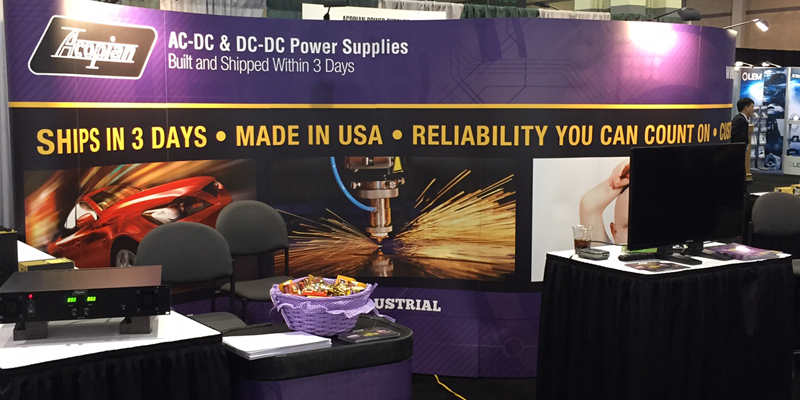
#poweryourway #acopianpowersupply #acopian
Add Comments
Posted by Acopian Power Supply
In : Blog Archive
Our third-generation family
commitment, old-school customer service, made-in-the-USA pledge, unsurpassed
product reliability, and millions of diverse power supplies designed to meet
any application deliver just what our customers need -- AND in record time! Read
what Acopian’s Director of Sales and Marketing, Alex Karapetian, has to say about what sets the company apart from other power-supply producers. Story Here.

#poweryourway #acopianpowersupply #acopian
Add Comments